PhD
Chemical Diversity in High-Mass Star-Forming Regions: A Comparison of Carbon-Chain and Complex Organic Molecules
Supervisor: Dr. René Plume
University of Calgary
The chemical makeup of gas clouds in the interstellar medium leads directly into that of planets and formed star systems. In the last few decades, a diverse suite of molecules have been observed in these regions. Typically, the chemical inventory of these regions includes two important categories: complex organic molecules, which are carbon-bearing saturated molecules with six or more atoms, and carbon-chain molecules, which are unsaturated hydrocarbons. There is, potentially, a dichotomy between these chemical types in star-forming regions.
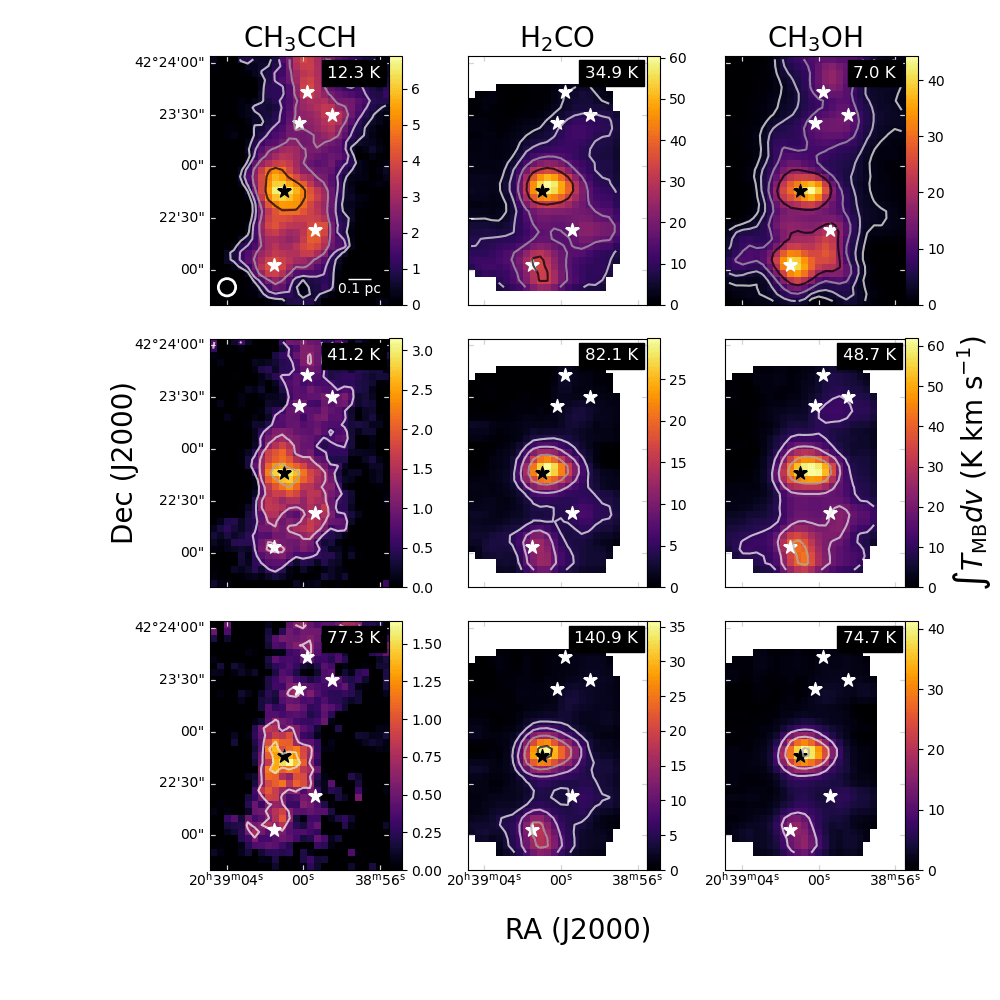
To collect data on carbon chain and complex organic molecules, I conducted spectral line surveys with the Green Bank Telescope and the IRAM 30-m Telescope of three massive star-forming regions in the Milky Way. These observations will tell us which molecules are in existence, their spatial distributions, and the physical conditions of these regions such as density and temperature. These results lead into developing chemical models to study the evolution of star forming regions. The results from these surveys on IRAS 20126+4104 and AFGL 2591 and on DR21(OH) are published in Astronomy & Astrophysics, using local thermodynamic equilibrium modelling to reveal the physical environment, and using chemical evolution modelling to then explain the chemical history.
You can find my thesis here.
For a brief overview, watch my webinar for the GBT on Youtube.
Master’s
The Development of a Modern Correlator for the DRAO Synthesis Telescope
Supervisor: Dr. Jo-Anne Brown
University of Calgary
You can find my thesis here
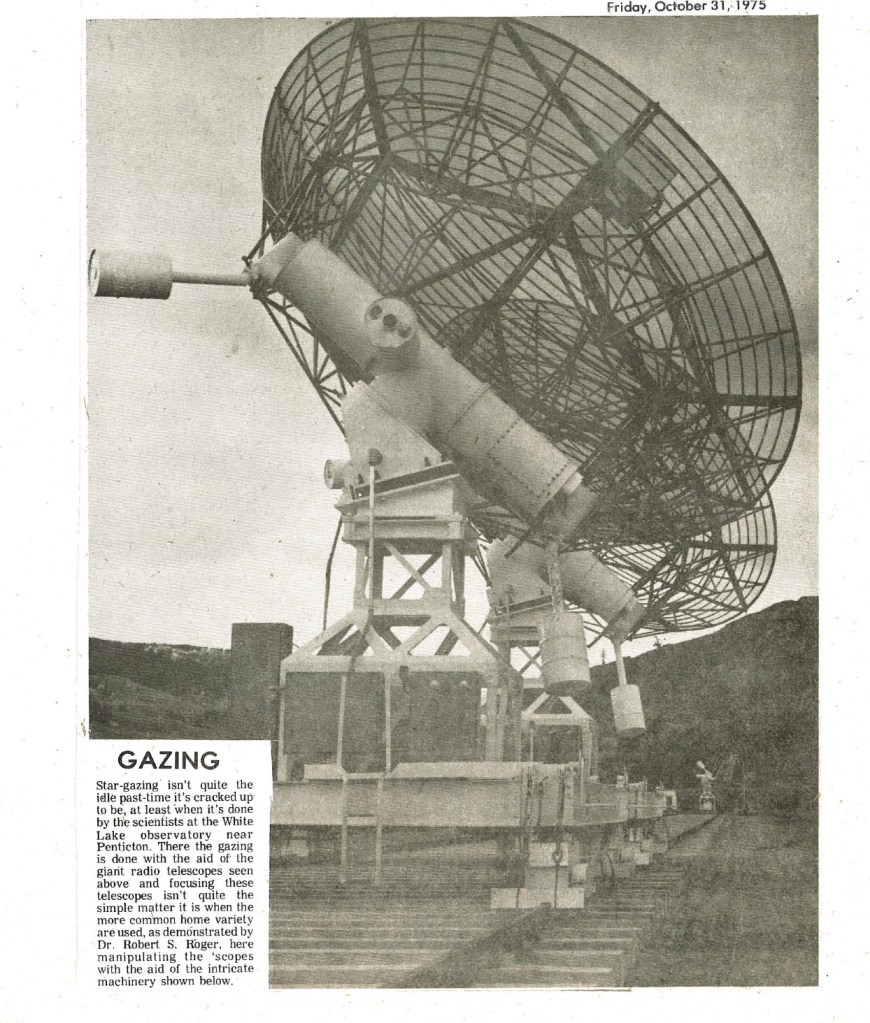
The development of computationally powerful and efficient instrumentation is a necessity in radio astronomy, and is possible thanks to recent commercial technological advances. In my Master’s project, I built and characterized a modern correlator for the Dominion Radio Astrophysical Observatory (DRAO) in Penticton, BC. The new ST correlator I constructed, replacing a decades-old, highly specified system, is based on the FPGA- and GPU-based design implemented at the Canadian Hydrogen Intensity Mapping Experiment telescope at the DRAO. I characterized the system’s radio frequency emissions, important for the radio-quiet environment at the DRAO. I installed the new correlator on the ST and performed observations with the old and new correlator systems in parallel to compare performance and data output. The raw data output and the resulting images match quite closely, demonstrating the success of the system and the capability to proceed with further ST upgrades.
As part of this project, I measured the radio frequency emission in and near Calgary, Alberta, to understand what our ambient radio environment is like. The results, published in Physics in Canada, demonstrate how necessary it is to regulate these emissions around radio observatories in so-called ‘radio-quiet zones’.
Image: Dominion Radio Astrophysical Observatory
 Pamela Freeman